Before and after ads work because they answer the only question a buyer actually has
Before and after ads show a visible transformation, split-screen or side-by-side, and let the viewer judge the result before they read a word of copy. The format has been advertising's most reliable proof mechanism for decades because it replaces a claim with evidence. Below are 8 category breakdowns of where the format wins, why it works psychologically, and what Meta before and after ads can and can't show on Facebook and Instagram, including the health, weight loss and cosmetic rules Meta revised in July 2026.
A buyer scrolling Instagram doesn't want to be told your product works, they want to see it, which is why this format keeps outperforming polished lifestyle shots. A before/after ad moves the burden of proof from your copywriter to your camera roll.
You'll find the format in almost every category that sells a visible outcome: skincare, fitness, cleaning products, home renovation, even B2B software dashboards. The mechanism stays the same across them. What changes is the policy limits and the "before" state that resonates with each buyer. Get those two details right and the format does most of the persuading on its own.
The psychology behind the format
A good before/after ad does three things at once, and getting them right is what separates a winning execution from a generic one.
It short-circuits skepticism
Every ad claim gets read with a discount applied. "Clears breakouts" gets mentally translated to "might reduce some breakouts, maybe, for some people." A photo of a real result doesn't ask for that leap of faith. The viewer isn't asked to trust a claim. They look at a picture and draw their own conclusion, which feels more like their own idea and less like being sold to.
It lets the viewer self-insert
The strongest before/after ads use a person who looks like the target buyer, not a professional model or an idealized outcome. When the "before" photo looks like an average person on an average day, the viewer imagines their own "after" without being told to. That mental leap is the conversion mechanism, not the after photo itself.
Specificity beats vague improvement
"Better skin" is forgettable. "Fewer visible breakouts after 4 weeks" sticks, because it gives the brain a number and a timeframe to anchor to. The strongest before/after ads pair the visual with one specific, plausible claim rather than a vague promise. Specific claims read as honest, and vague ones read as marketing.
8 category breakdowns where before/after wins
1. Skincare and beauty
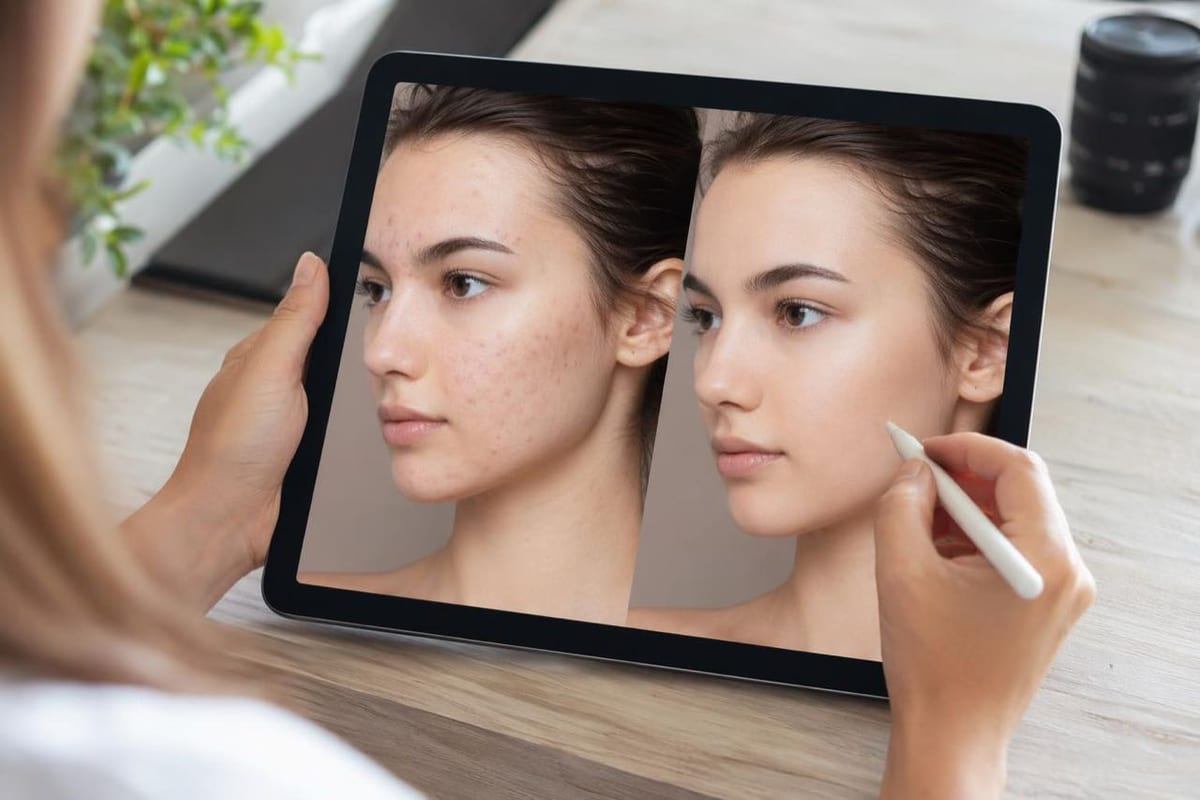
This is the oldest and most common use of the format. A split-screen face shot with similar lighting and angle on both sides, plus a short timeframe caption ("after 30 days"), does most of the work. A strong skincare before/after differs from a generic one in consistency of conditions: same lighting, same angle, same expression. Inconsistent conditions between the two photos read as staged, even when the result is real.
2. Fitness and body transformation
Fitness before/afters work on the same mechanic but carry the heaviest policy risk (more on that below). The best-performing versions pair the visual with a process detail, not just an outcome. "8 weeks, 3 sessions a week" reads as achievable. A dramatic transformation with no timeframe or process context reads as unrealistic, and when it promotes a weight loss product, Meta's rules require the timeframe anyway.
3. Home organization and cleaning
A cluttered pantry next to the same pantry organized, or a stained carpet next to the same carpet after a cleaning product, is one of the highest-performing non-beauty uses of the format. The "before" is instantly and universally relatable. Almost everyone has a junk drawer or a closet they're embarrassed by, so the emotional hook lands without a testimonial.
4. Home improvement and renovation
Kitchen and bathroom remodels, deck restorations, and exterior paint jobs all use before/after heavily, usually in carousel or slideshow format so the viewer can swipe through multiple angles of the same space. The format fits especially well here because the purchase is high-consideration. Seeing a real transformation reduces the perceived risk of a decision that might cost thousands of dollars.
5. Pet grooming and pet care
A matted, overgrown dog next to the same dog freshly groomed is a reliable performer for local service businesses. It borrows the relatability mechanic from home organization: pet owners recognize the "before" state immediately and want the "after" for their own pet.
6. Auto detailing and car care
Interior and exterior detailing services use before/after constantly, often as a short video showing the wipe-down in real time rather than a static split image. Motion adds credibility a static photo can't, because the viewer watches the transformation happen instead of trusting two separate snapshots.
7. Software and workflow tools
B2B and SaaS brands adapt the format to show a cluttered spreadsheet or inbox next to a clean, organized dashboard after the tool is applied. It's a less literal use of "before/after," but the mechanism is the same: the viewer's pain point (a messy process) shown next to the resolved state. This works best when the "before" is something the buyer recognizes from their own workday, not a generic stock screenshot.
8. Weight management and nutrition
This category performs strongly but sits under the tightest Meta policy scrutiny of any use case here. Real results with context (timeframe, method), shown to adults, can run. Fat-pinching close-ups, appearance-shaming copy, and promises of a specific result in a set time without qualifiers are the fastest route to a rejection. The full rules are in the next section.
Meta before and after ads: what the policy actually allows
Meta doesn't ban before and after ads. It restricts them by category, and the rules for health, weight loss and cosmetic products sit in the Health and wellness section of its Advertising Standards. That page's change log shows a revision on 22 July 2026, so older advice that "Meta bans all before/after images" is out of date. Here is what the current Health and wellness policy says, category by category.
Weight loss and weight gain products
Ads for dietary, health, weight loss or weight gain products and services must be targeted to people 18 or older. You can show the product working: for dietary weight loss products, Meta says the ad "can illustrate people using the product or the service," and must "clearly indicate the time taken to achieve noticeable results." A before/after without a timeframe fails that test.
Two things are off the table. Ads can't depict a "close up on specific body area by pinching fat," or "claims that results can be achieved solely by using wearable products." Meta also prohibits "sensational language with exaggerated or extreme claims" and "promises of specific outcomes within a set timeframe without disclaimers or qualifiers" in a health or weight loss context.
Cosmetic products, procedures and surgeries
Before/after is explicitly allowed for adults. Among the ads advertisers can run when targeting people 18 or older, Meta lists "general cosmetic products, procedures, surgeries depicting before and after transformation."
Age targeting is mandatory. Ads promoting cosmetic products, procedures or surgeries must target people 18 or older. Some non-permanent beauty products are exempt from the age rule, so check the exemption list for your product. Skin whitening or bleaching products that cause permanent skin colour change can't be promoted at all.
Rules that apply to the copy, not just the image
Weight loss and cosmetic ads can't contain "statements of inferiority about physical appearance," meaning negative terms, descriptions or questions about someone's appearance, body parts or hygiene. "Embarrassed by your belly?" fails. "Our 12-week program, start to finish" doesn't.
Meta's privacy and personal attributes policy adds that "ads must not contain content that asserts or implies personal attributes," including "physical or mental health (including medical conditions)." Headlines like "Struggling with your acne?" imply the viewer has the condition. Rewrite them to describe the product, not the person.
Meta also keeps a plainer-language summary in its Business Help Center, About Meta's advertising policies on health and wellness. When the two disagree, the Transparency Center page is the rulebook, and it is the one Meta updates first.
How to run compliant before and after ads on Facebook and Instagram
The policy is narrower than most advertisers assume, but the review is strict about the details. Run every before/after through this checklist before you launch:
- Set the age targeting to 18+ for anything in weight loss, weight gain, dietary or cosmetic categories, even if your product feels mild.
- Put the timeframe on the image or in the first line of copy, for example "After 12 weeks" or "after one session." For weight loss it is a policy requirement, not a nice-to-have.
- Describe the product, not the viewer. Strip "you," "your" and questions about the viewer's body or condition from headlines and primary text.
- Keep the visual honest. Use the same lighting, angle and framing in both photos, with no retouched "after" and no fat-pinching or body-part close-ups.
- Add qualifiers to any specific outcome. "Results vary" plus the method beats a bare "lose 10 kg in a month," which reads as clickbait under Meta's rules.
- Get written consent and keep your records. Real customer photos need permission, and you want documentation ready if a review asks for substantiation.
- Plan for Reels placements. On Instagram Reels, keep the before/after labels and timeframe out of the top 14% and bottom 35% of the frame, where Meta's interface covers them (Meta Ads Guide). The Instagram Reels ad specs has the full safe-zone table.
Policies change, and enforcement doesn't always match the written rule. If an ad is rejected and you believe it complies, request a review from Account Quality rather than re-uploading the same creative, and budget extra review time for health and cosmetic launches.
How to structure your own before/after ad
Keep the format simple and let the contrast carry the ad:
- Same conditions in both photos. Use the same lighting, angle and framing. Anything that differs between the two photos gives the viewer a reason to doubt the result.
- Make one specific claim, not a paragraph. A single line with a number and a timeframe beats three lines of benefits.
- Use a real subject over an idealized model. A relatable "before" state does more conversion work than a polished "after" state.
- Always caption the timeframe. "After 30 days" or "after 3 sessions" turns a photo into a plausible process instead of a magic trick.
- Check your category's policy before you brief the shoot. Plan health, fitness, weight loss and cosmetic creative around Meta's rules from day one, not as a patch after a rejection.
If you want more formats to test against this one, our static ads vs. video ads breakdown covers when a still image like a before/after outperforms motion, and our ad hook formulas for e-commerce piece has openers built to pair with a visual proof format like this one.
Another test worth running is pairing the before/after visual with a UGC-style delivery instead of a polished studio shot. A real customer holding up their own before/after, filmed on a phone, often outperforms a professionally lit split-screen because it looks less like an ad. Our complete guide to UGC ads walks through how to brief and source that kind of creative if you don't already have a customer content pipeline running.
Before you brief the shoot, check what competitors in your category are already running. Pull up 3 to 5 brands in your space inside the Meta Ads Library and note which before/after formats have stayed active the longest. Longevity is the simplest signal that a specific version of this format is converting, not just running as a test.
FAQ

Are before and after ads allowed on Facebook and Instagram?
Yes, with limits. Meta's Health and wellness policy allows cosmetic products and procedures that depict before and after transformation when targeted to people 18 or older. Weight loss ads can show people using the product but must state the time taken to see results, and can't use fat-pinching close-ups or appearance-shaming copy.
What gets Meta before and after ads rejected?
The usual causes are copy that implies the viewer has a condition ("Tired of your acne?"), negative statements about appearance, close-ups pinching fat, a specific result promised in a set time without qualifiers, and missing 18+ targeting in weight loss or cosmetic categories. Fix the copy first, since it is the most common problem.
What makes a before and after ad convert better than a regular product ad?
It replaces a claim with visual evidence. Instead of asking the viewer to trust a copywriter's promise, it shows a plausible outcome and lets them draw their own conclusion, which reads as more credible than a stated benefit.
Do before and after ads work outside of beauty and fitness?
Yes. Home organization, home improvement, pet grooming, auto detailing, and B2B software tools all use the same before/after mechanic successfully, adapted to show a "cluttered/messy" state next to a "resolved" one.
How long should the timeframe be in a before/after ad caption?
Whatever is true and typical for your product, stated specifically. "After 30 days" or "after one session" both work because they're specific and plausible. Leaving out a timeframe entirely is one of the fastest ways to make a real result look staged.
Can I use a customer's real photo in a before/after ad?
Yes, with the customer's written consent and, for regulated categories like health or fitness, documentation you can produce if Meta's ad review asks for it. Real customer photos usually read as more credible than staged or model-based versions of the same format.
When before/after is the wrong format
Not every product has a visual "before" worth showing. A subscription box, a project management tool with no visible clutter to fix, or a service that sells ongoing peace of mind rather than a single fixable moment won't map cleanly onto a split-screen. Forcing the format onto a product without a real before-state usually produces a staged-looking ad that undercuts the credibility the format is supposed to build. If your product has no obvious, photographable "before," a testimonial-led or founder-story hook will likely outperform a forced before/after.
Build your next before/after ad with a proven hook
Before/after works because it shows the result before it asks for the click. Pair that visual with a hook that earns the scroll-stop in the first place: browse our 1,500+ free AI ad prompts and real ad teardowns, and get one new winning hook breakdown every week in the newsletter.

The AI Ad-Making Kit
$99Make hyperreal AI video and image ads for any brand, with free AI tools. No camera, no agency.
- 10 modules
- 300+ hooks
- 500+ prompts
Canva ad templates, free.
Proven D2C ad layouts. Swap in your product, export, launch.
Browse templates →Want to act on what you just read?
Browse 3,400+ free, Canva-ready ad templates sorted by industry. One click to open, five minutes to customise.
Browse Free Templates