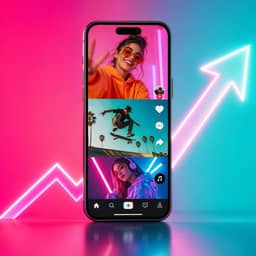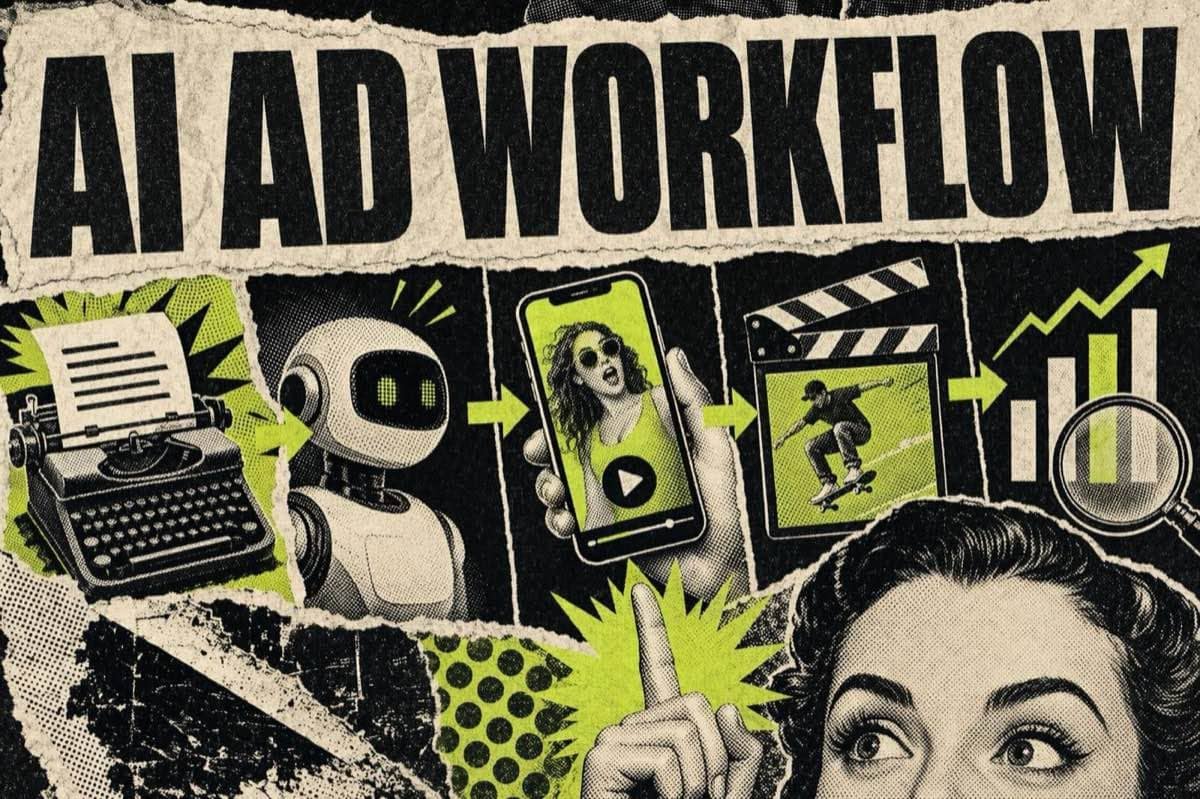
Making AI video ads takes six steps: pick one angle, write a script built around a 3-second hook, generate the video with an AI actor or avatar tool, add captions and sound, test 3-5 hook variations against the same body, then scale the variant that holds attention longest. Export one 9:16 vertical master, keep text out of the interface zones, and the same ad can run on Instagram Reels, YouTube Shorts and Meta's other vertical placements.
You don't need a camera, a studio, or a slot on a creator's calendar. The creative steps below are the same wherever short vertical video runs. The export, the safe zone and the buying platform change per placement, and those get their own section further down.
Step 1: Pick one angle, not five
Before any AI tool opens, decide what single claim this ad is testing. "This serum clears breakouts in 2 weeks" is an angle. "Great skincare for everyone" is not. It's five different ads pretending to be one.
Media buyers who skip this step end up with a video that tries to say too much and converts nothing. Pick the angle from a real customer objection, a specific use case, or a before/after moment. If you're short on angles, the free AI prompt library has prompts built for drafting ad scripts and hooks by category.
One angle also makes every downstream step faster. The script writes itself around a single claim, and the hooks you test later are variations of the same idea, which is the only way to get a clean read on what's working.
This step goes wrong most often when someone folds a discount, a new feature, and a customer testimonial into one 20-second video. Each of those is a different angle with its own proof mechanism. Test them as separate ads, not as one crowded script.
Where AI actually changes the workflow
Testing a new ad angle used to mean briefing a creator, waiting days for footage, then editing and hoping the hook landed. AI collapses that into an afternoon. The angle-to-live-ad loop that took a week can run several times in a day, so the constraint moves from production time to how fast you can read the data and decide what to test next.
The biggest cost in creative testing was never the video. It was the waiting. A media buyer who tests five hooks by Thursday instead of one hook next month finds a winner sooner and spends less budget getting there.
Operators building businesses on this describe the same math. One AI-video creator laid it out this way: "ad creative fatigues in 2 to 3 weeks, not months," so "to find one winner, brands test 20 to 30 variants a cycle," and "about half of brands are expanding ugc spend, roughly none are cutting" (@RetroChainer). Treat the exact ratios as one operator's numbers rather than gospel. The direction holds: the job is volume, and an AI workflow supplies volume.
Step 2: Write the script around a 3-second hook

The first 3 seconds decide whether anyone sees the rest of your ad. On Shorts the feed is built around that decision: Google's own help center says Shorts ads "are immediately skippable by swiping up or down" (Google Ads Help). There is no five-second grace period. If the opening doesn't earn the next second, the thumb moves.
A workable script structure:
- Hook (0-3 sec): A claim, a question, or a visual pattern interrupt. No logo, no "hi guys," no slow build.
- Proof or demonstration (3-15 sec): Show the thing working. A before/after, a reaction, a specific number.
- Objection handling (15-25 sec): Address the one thing a skeptical viewer is thinking.
- CTA (last 3-5 sec): One instruction. Not "check it out," something specific like "tap the link to get 20% off today."
Keep the whole script under 30 seconds for a first cut. Google recommends 10-30 second vertical videos for action-oriented Shorts ads (Google Ads Help), and shorter cuts cost less to generate and are easier to test in volume. If you'd rather start from structured formulas than write hooks from scratch, the ad hook formulas for e-commerce guide has fill-in-the-blank templates that adapt directly into a script. Shorts hooks vs Reels hooks covers how the same opener leans differently on each feed.
Step 3: Generate the video with an AI actor or avatar
This is where AI replaces the camera crew. Tools like Arcads, Creatify, and HeyGen turn a script into a spoken-to-camera video with an AI actor in minutes rather than days. You paste the script, choose an avatar that fits your audience, and the tool syncs voice, lip movement, and basic scene framing.
Output quality comes down to three things:
- A polished corporate-looking avatar undermines a UGC-style angle, so pick an avatar that looks like it belongs in the setting your angle implies.
- AI voice generation reads scripts literally. Short sentences with natural pauses sound more human than long compound ones.
- Use vertical 9:16, handheld-style camera movement if the tool supports it, and natural lighting presets over studio ones.
We compare the major AI ad tools, including where each one is strongest, in the AI ad generator comparison and the roundup of AI UGC ad generators.
Step 4: Add captions, sound, and native editing touches
A talking-head clip on its own isn't a finished ad. Add burned-in captions, a voiceover or music bed, and basic B-roll or product cutaways if the tool supports them.
Static-first teams tend to underrate sound. Google's Shorts guidance says to use music, voiceover or both, and reports that sound in Shorts ads "has been shown to increase conversions by over 20%" (Google Ads Help). Meta's Reels ad spec lists sound and captions as optional but recommended (Meta Ads Guide).
Keep licensed tracks out of the audio. Meta's Reels ad guide says licensed music isn't allowed in Reels ads and points advertisers to original audio or its own sound collection. On YouTube, Google tells advertisers to use royalty-free tracks from the YouTube Audio Library or clear the rights first (Google Ads Help).
Two things separate an ad that reads as native from one that reads as an obvious AI clip:
- Captions styled to match the platform's native caption look, not a generic subtitle bar.
- A short pause or breath between the hook and the next line. Perfectly smooth AI pacing is one of the easiest giveaways that a video was made by AI, and viewers who catch it discount the message.
This is the most important step in the workflow, and AI tools are built for it. Keep steps 2 through 4 identical, then generate 3-5 different opening lines for the same script body. Regenerating the first 3 seconds costs a fraction of reshooting a whole video, so one concept becomes a real test instead of a guess.
Step 5: Generate 3-5 hook variations on the same body
Test structure that works:
- What changes — What stays the same
- Opening hook line — Script body, avatar, CTA
- Opening visual (talking vs. text-on-screen) — Offer, proof point
- Question hook vs. statement hook — Everything else
Judge the variants on 3-second view rate or hold rate first, not on total engagement. A hook that gets comments but doesn't hold attention past 3 seconds is a distraction, not a winner. On YouTube, Google Ads shows per-second watch time for Shorts ads under Assets, then Videos, then Analytics, so you can see exactly where each variant loses people (Google Ads Help). If you need a faster way to draft variations, the free AI hook generator produces multiple openers from one product description.
Step 6: Scale the winner and watch for fatigue
Once a hook variant clearly beats the others, put spend behind it and hold the losing variants for a later test cycle instead of deleting them. A hook that loses against one body sometimes wins against another.
Creative decay moves fast. Zentric Digital's Meta creative fatigue playbook argues that "a single ad concept burns through its audience in 2-3 weeks, down from 6+ weeks just two years ago," and lists prospecting frequency above 3.0 as a fatigue signal. Generate your next batch of hook variants before the current winner starts declining, not after. The creative fatigue guide covers the warning signs in more detail.
Export specs: one master, three placements
The creative is shared, but the export, the safe zone and the buying platform are not. Build one 9:16 master and check it against this table before you upload.
- Spec — Instagram Reels ads — YouTube Shorts ads
- Aspect ratio — 9:16 — 9:16 (recommended)
- Resolution — 1440x2560 recommended — 1080x1920 recommended
- Length — Up to 15 minutes — Up to 3 minutes; only the first 60 seconds play in the Shorts feed
- Recommended length — Short; the hook decides it — Under 60 seconds; 10-30 seconds for action-oriented ads
- Text safe zone — Keep text and logos out of the top 14%, bottom 35% and 6% on each side — Use Google's vertical safe-zone template; the right rail carries like, comment and share buttons
- Licensed music — Not allowed — Use YouTube Audio Library or cleared rights
- Bought in — Meta Ads Manager — Google Ads (Demand Gen, video view, Performance Max and others)
Sources: Meta's Reels ad spec, Google's Shorts asset specs, Google's video ad specs and safe zones, and Google's Demand Gen asset specs, which mark 1080x1920 as "Recommended for YouTube Shorts."
Three practical consequences:
- Master high and export twice. Build at 1440x2560 for Reels and export a 1080x1920 copy for Shorts. It's the same footage with one extra render.
- Design for the tighter safe zone. Meta's bottom 35% rule is the strictest, so offer text that clears it will also clear the Shorts CTA button. Keep hook text in the middle band.
- Upload Shorts creative to YouTube first. Google requires the video to be on YouTube (public or unlisted) before a campaign can use it as a Shorts ad (Google Ads Help).
For the full breakdowns, see YouTube Shorts ad specs, Instagram Reels ad specs, and Story and Reels ads for how Reels and Stories placements differ on Meta. If you're new to buying on YouTube, the YouTube Shorts ads guide walks through campaign types and setup.
One compliance note before you launch

If your finished ad uses an AI-generated photorealistic human, label it before you spend. Both platforms now say so directly.
Meta says it shows an "AI info" label on ads made or significantly edited with its own generative tools. It puts that label next to "Sponsored" when the tool produced a photorealistic human, and it has begun "automatically detecting ads created or edited using third-party AI tools through industry-standard signals" (Meta Newsroom). Google's Shorts asset guidance notes that AI regulations in the EU, India and New York require disclosures on certain AI-generated or edited ads. You can add labels in the creative or through the AI label setting in Google Ads (Google Ads Help). Label first, because finding out after a live campaign gets flagged costs you the momentum you paid for. The guide to using AI actors safely covers disclosure and likeness rights in more depth.
FAQ
Can I make AI video ads for free?
Most AI video ad tools have a limited free tier, usually a handful of watermarked credits, enough to test the workflow before you commit to a paid plan. Full production runs (multiple hook variants, HD export, no watermark) usually need a paid subscription. The free AI prompt library covers the scripting side at no cost, whichever video tool you use.
How long should an AI-generated video ad be?
For a first test cut, aim for 15-30 seconds. Google recommends 10-30 second vertical videos for action-oriented Shorts ads, and only the first 60 seconds of any Shorts ad play in the feed. Shorter cuts cost less to generate and make it easier to tell whether the hook or the body is driving results.
Can the same AI video ad run on Reels and Shorts?
Yes. Both are 9:16, sound-on, swipe-driven feeds, so one master works. Export 1440x2560 for Reels and 1080x1920 for Shorts, keep text clear of the bottom 35% and the right rail, and avoid licensed music. The campaigns are built separately in Meta Ads Manager and Google Ads.
Do AI actors perform as well as real human creators?
They can for the narrow job of testing hooks and angles cheaply, since generating multiple script variations costs a fraction of hiring several human creators. They don't replace human creators for scaled, long-term campaigns, where a real reaction and a creator's following still carry weight a synthetic actor can't replicate.
What's the biggest mistake marketers make with AI video ads?
Generating one video and calling it done. The point of AI ad generation is that you can cheaply produce multiple hook variations for the same script body and let real view-rate data pick the winner, instead of betting your budget on a single untested cut.
Steal a hook before you generate anything
The workflow above only works if the angle and hook are strong to begin with. No AI tool fixes a weak idea. Before you open a video generator, pull openers from the ad hook bank, study how winning ads structure their first 3 seconds in the ad teardowns, and draft your first script from the free AI video ad prompts.
The AI Ad-Making Kit
$99Make hyperreal AI video and image ads for any brand, with free AI tools. No camera, no agency.
- 10 modules
- 300+ hooks
- 500+ prompts
Canva ad templates, free.
Proven D2C ad layouts. Swap in your product, export, launch.
Browse templates →Want to act on what you just read?
Browse 3,400+ free, Canva-ready ad templates sorted by industry. One click to open, five minutes to customise.
Browse Free Templates