Creative strategy is the plan for what your ads say, to whom and in what form, written before anyone makes an ad, plus the test that tells you whether it worked. It sits between knowing your customer and producing creative. Skip it and you end up making ads from taste, with nothing learned from the results.
In practice it comes down to four steps: pick an angle, choose a concept to carry it, write a hook, then run a test that changes one thing. The rest of this page defines each step, walks through it on two real ads, and ends with a checklist you can copy.
What does creative strategy mean?
Creative strategy is a written answer to three questions before production starts: who is this ad for, what do they already believe, and which argument would move them. What comes out is a short list of testable ideas and a rule for judging them. It is not a finished ad.
Three things it is not:
- It is not design or branding. Branding is how a company looks and sounds everywhere. Creative strategy covers the job of one specific ad.
- It is not copying a competitor. A competitor's ad shows you a format and a hook, but not who they aimed at or why they chose that argument. Researching competitor ads gives you leads, not answers.
- It is not a one-off. A strategy is a loop: you decide, test, learn and decide again. The person who does this full time is a creative strategist, and our guide to becoming a creative strategist covers the job, the pay and the portfolio.
What is the angle, concept, hook, test framework?

The framework runs in four steps, always in the same order. The angle is the argument and the concept is the form that carries it. The hook is the opening line or frame, and the test is a fair comparison that tells you which version wins. Each step narrows the one before it.
- The angle is one reason to act, for one audience. "A gift she will wear every day" is an angle. "Our necklace is high quality" is a claim, because it names no person and no moment.
- The concept is the form that delivers the angle: a customer story, a price breakdown, a before and after, a comparison, a demo. One angle can have many concepts.
- The hook is the first line or first frame, and its only job is to make the right person keep watching or reading. One concept can have many hooks, which is why hooks are the cheapest thing to test.
- The test changes one thing. State the metric and the stop rule before you start, and write down what you learned whichever version wins. Our ad creative testing system explains how to set that up on Meta.
Work in that order. Start with the hook and you end up testing wording on an argument nobody wanted. Start with the angle and a weak hook costs you one line, not the whole idea.
The Creative Ads Course goes deeper on each step, and the hub page on ad creative links the rest of our guides.
How does the framework look on real ads?
Run the framework over two live ads from our ad-example pages and it separates what each advertiser chose. Both are image ads from the public Meta Ad Library, and the annotations are ours. We don't know either brand's results. The pages only show that the ads are running and since when, so the point here is how to read them.
The first is Lucky Bear's personalised initial necklace (jewelry ads, running since March 2024). The copy opens on a customer quote, "My sister said this necklace was the most thoughtful gift", and goes on to say she now wears it every day. Then come "Customize up to 7 initials", a "Sale Ends Today" line and a Shop now button.
- Angle: a gift that shows thought, aimed at the person buying for someone else.
- Concept: a customer's gift story.
- Hook: the sister's reaction in the first line.
- Support: personalisation, free shipping and a deadline give extra reasons to act.
The second is a vegetarian meal-kit box from Acme Farms + Kitchen (food ads, running since March 2026). The copy asks about "an affordable option for local food delivery". It says the box holds 3 family-size meals, each serving 4, for $104, and that "That's $8 a serving!" The headline calls it the "PNW's local first meal kit", and the photo is a bowl of pasta.
- Angle: a family meal kit that is affordable and local.
- Concept: a price breakdown, with the maths done for the buyer.
- Hook: the per-serving price in the first lines, next to an appetising dish.
- A caution: by our arithmetic, $104 over 12 servings is $8.67, so the ad rounds down. Check a number like that before you borrow its structure.
The two ads run on the same platform in the same format and still make different strategic choices. The skill is learning to see those choices. For more examples sorted by format, see image ads.
What would a first test look like?
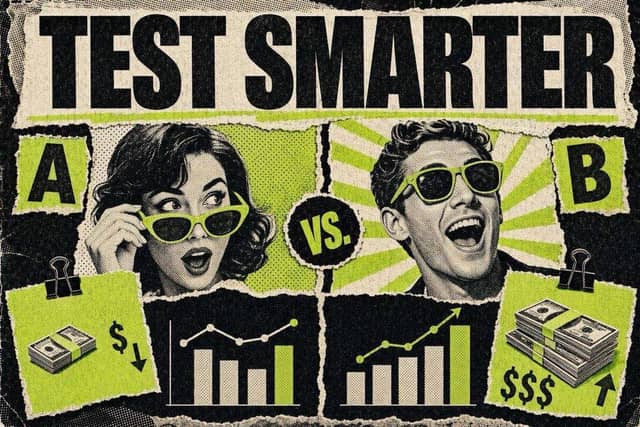
Your first test should hold the angle and concept fixed and change only the hook. Using the Lucky Bear structure as an example, that means the same gift angle and the same customer-story concept with two different opening lines. Show both to the same audience on the same budget, and judge them on one metric you picked in advance.
Write down the stop rule before you start. For example: "run until each ad has spent the same amount, or for seven days, whichever comes first; pick the lower cost per purchase if the gap is clear, otherwise call it a tie." You set the numbers in that rule for your own account. On a small spend, expect to call a tie more often than you'd like.
After that, move one level up. When a hook wins, test a second concept for the same angle. When a concept wins, test a second angle. Log every test and its result, losers included.
Creative strategy checklist
Copy this list into a doc and fill it in before you brief your next ad.
- [ ] Who is this ad for? Name one person, not a segment.
- [ ] What do they already believe about the problem, and about products like yours?
- [ ] What one argument would move them? Write it as a sentence.
- [ ] Is that an angle (an argument aimed at a person) or a claim (a statement about the product)?
- [ ] Which concept carries it: customer story, price breakdown, comparison, demo, before and after?
- [ ] Have I written at least three hooks for the same concept?
- [ ] Can I show proof for every claim in the ad?
- [ ] What is the one thing this test changes?
- [ ] Which metric decides the winner, and what is the stop rule?
- [ ] What will I do if both ads lose?
- [ ] Where will I record the result, win or lose?
- [ ] What will I test after this?
How we checked

We read the two ad-example pages on 1 November 2026 and report only what they show: the copy, the start month, the hook and the annotations. We did not look up results for either advertiser. The test example is an illustration, not a result.
Your next step is to pick one product, fill in the checklist above and write three hooks for your best angle. For the full method, read the first lesson of the Creative Ads Course free.
Sources
- HookAds ad examples, Jewelry ads and Food ads, read 1 November 2026. Both pages link each ad to its entry in the Meta Ad Library.
The AI Ad-Making Kit
$99Make hyperreal AI video and image ads for any brand, with free AI tools. No camera, no agency.
- 10 modules
- 300+ hooks
- 500+ prompts
Canva ad templates, free.
Proven D2C ad layouts. Swap in your product, export, launch.
Browse templatesWant to act on what you just read?
Browse 3,400+ free, Canva-ready ad templates sorted by industry. One click to open, five minutes to customise.
Browse Free Templates